Isobel Gowdie - The Witch and the Hare

I shall go into a hare,
With sorrow and sych and meickle care;
And I shall go in the Devil's name,
Ay while I come home again.
Those that have been reading my newsletters recently will know that I’ve been working on a new folk horror novella called “Mask of the Hare.” It’s currently sitting with my editor, and while I wait for feedback, I wanted to take some time talking about the inspiration behind this story.
I remember clearly the moment I realised I had to write a book about a witch and a hare. It was during a visit to Boscastle’s Museum of Witchcraft and Magic, I was there visiting with my kids on a weekend away while my partner was abroad for work, and amongst all the quite wonderful exhibits, the one that really stood out to me was Hare Woman by Lionel Miskin. To be clear, the entire museum is sublime, housing the largest collection of witchcraft related objects and artefacts in the world. It’s one of my favourite museums and one I never miss a chance to visit whenever I find myself in Cornwall (which is often!), but this particular artefact is probably the most striking of all to me.
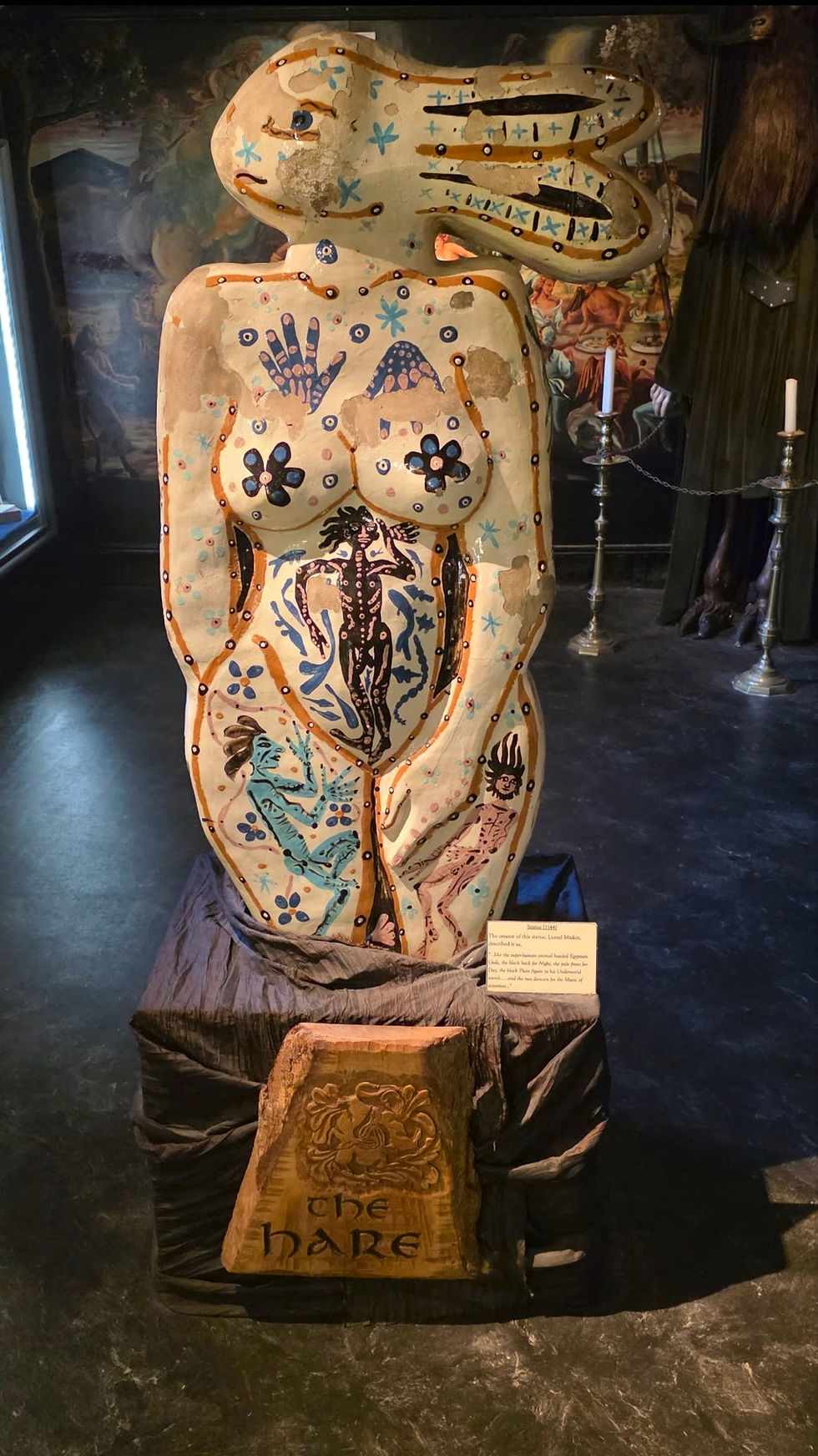
The hare itself is such a wonderful creature and I’m lucky enough to occasionally spot one running across the chalky plains here in Wiltshire, especially at this time of year when they are particularly active. I’ve seen lots this year during my role as a volunteer at Stonehenge. Whenever one silently stares at you with those bead-like black eyes, it has a way of stopping you still as if something else is watching you closely. It’s an exhilarating experience.
I began to research the link between the hare and witchcraft and it didn’t take long before I came upon the story of The Witch of Auldern - Isobel Gowdie, a Scottish woman who confessed to witchcraft in the mid 1600s. This era was a particularly turbulent time in Scotland and after Mary, Queen of Scots passed the Scottish Witchcraft Act in 1563, it is estimated that over 2500 people, mostly women, were executed as witches until its repeal in 1736. What sets Isobel Gowdie somewhat apart are her detailed, public confessions of which she describes, amongst many things, transforming into a hare.
Very little is actually known of her life beyond that fact that she was married to a man named John Gilbert, and they lived in the Loch Loy area a few miles north of Auldern. It’s often estimated that she was somewhere between thirty and fifty years of age and would likely have spent her time supporting her farm labourer husband. However, while her past is somewhat a mystery, it’s her confessions that have survived the passing of time, which after being lost for over 200 years, were published in 1883 within historian Robert Pitcairn’s Ancient Criminal Trials in Scotland, a huge collection of Scottish High Court of Justiciary records from the time. The transcriptions were preserved by the Bannatyne Club and can be found via the National Library of Scotland at the below link:
These confessions are one of the most important records of witchcraft folklore and beliefs from that era and it’s within these confessions that she first mentions the ability to transform into a hare. It was during her second confession on 3rd May 1662, that she claimed the ability to transform in to various animals and outlined in detail, the chants that enabled these transformations. To transform into a hare, she would chant:
I shall go into a hare,
With sorrow and sych and meickle care;
And I shall go in the Devil's name,
Ay while I come home again.
And to transform back into a woman:
Hare, hare, God send thee care.
I am in a hare's likeness now,
But I shall be in a woman's likeness even now.
What prompted Isobel Gowdie to make these confessions has long since been lost. Some think it was the result of psychological torture or even of mental illness, but what became of Isobel Gowdie afterwards is unknown. There is record that she, alongside her supposed accomplice Janet Breadhead, were sent to stand trial for witchcraft, but beyond that, nothing is known. Sadly, it’s likely they shared the same monstrously unjust end as most women found guilty of witchcraft at the time, which was to be executed by strangulation then burned.
I like to think that maybe this wasn’t the fate that Isobel Gowdie experienced, and that perhaps a more compassionate outcome prevailed. Maybe she was acquitted on the basis of mental impairment, as some historians suggest, and permitted to return to a somewhat more quiet obscurity. We’ll never know, but what she leaves behind is a fascinating record of folkloric beliefs, many of which prevail today.
For more folklore inspired fiction and to sign-up to my free serialised pirate themed fantasy “The Book of Morag Mayes”, check out the links below:

Comments